It is domestic policy distortions and inaction to correct them that lie behind the large CADs.

The fund industry may have embraced machines and robots, but managing money still needs the human touch
North Korea considers Assad's Syria an ally, so it views Donald Trump's decision to strike Syria as a message to Pyongyang as well.

Shankar Acharya gives ten predictions on key politico-economic developments in the world and ten for India.

Chinese President Xi Jinping's visit to India is a time for the two countries to get away from the haze of rhetoric and stale euphoria, says Sana Hashmi.

Make in India has few advantages and some disadvatnages too.

'In the run-up to the summit, Trump had indicated that he might strike a nuclear deal in the course of a single meeting or over several days, but as it transpired, Trump departed Singapore soon after the meeting.' 'This raises questions if his aspirations for an ambitious outcome had been scaled back,' says Rajaram Panda.

Prime Minister Manmohan Singh on Sunday left for a five-day visit to Russia and China.

Sensex eneded 374 points higher on rate cut expectation from the RBI.
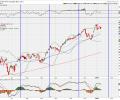
It is too early to say if we have seen the "final" bottom to these stocks in August 2013 or if another attempt to test them will be made before or just after elections, says Sonali Ranade.

Prime Minister Narendra Modi's opinion piece in Canada's The Globe and Mail focuses on commercial cooperation in the civil nuclear energy sector.

Elliott Capital's letter to Cognizant, detailing how the latter can reinvent itself, has many lessons for its India-listed peers like TCS and Infosys, says Akash Prakash.

'She dwarfs every known politician of recent times with her imperious aura, iron will, tremendous drive, dauntless pursuit of goals she set before herself, ability to capture the people's imagination and unshakeable grip over her party and government,' says B S Raghavan, the distinguished civil servant.
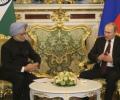
In a clear attempt to allay Russia's apprehensions, Prime Minister Manmohan Singh on Monday said it will remain an "indispensable" partner for India's defence needs even as he underlined that the bilateral ties should adapt to changing times to address challenges.

'The debate is not whether the Indian defence apparatus is in a state of disrepair, but whether it is capable of securing the defence of the country if any envisaged threat becomes real.'

Chirag Mehta, senior fund manager -- alternative investments at Quantum AMC, shares his views.

Richard Clarida's recent paper could be key for policymakers in deciding whether India should move to an 'inflation targeting policy regime', says Vivek Dehejia.

India on Wednesday asserted there can be no military solution to the lethal Syrian conflict and societies cannot be "re-ordered from outside" as people have the right to choose their own destiny.

Think organic food, affordable homes, artificial intelligence, suggests Prof Manmeet Barve.

The film whirrs along from disjointed scene to disjointed scene, the only intriguing ones being weird B-movie moments that turn out, far too frequently, to be Batman's dreams, says Raja Sen

It seems China is ready to cooperate with India in the central Asian region through the SCO framework, the reasons for which are manifold, says Sana Hashmi.

'We are two countries that, as Swami Vivekananda said in Chicago more than a century ago, have sheltered the persecuted and the refugees of all religions and all nations on Earth.' 'People are watching to wait and see if this Modi moment is going to be the moment when the world's oldest democracy and the world's largest democracy finally capitalise on the full, inherent potential of this relationship.' Aziz Haniffa/Rediff.com reports from the State Department's lunch for Prime Minister Modi.

'As they grow bigger, the trail of their pioneering success often leaves behind a causticity marked by deficient human resource practices, negligible focus on corporate governance and rife sexism.'

New Delhi and Beijing are the only two regional capitals that have commented on US President Donald Trump's speech on August 21 outlining the way forward in Afghanistan. The Indian foreign ministry statement was effusive in praise, while the Chinese statement has been one of cautious and guarded hope. Delhi has identified itself with Trump's Afghan strategy, whereas the Chinese stance is calibrated -- observant and objective, keeping a distance, says Ambassador M K Bhadrakumar.

You cannot sow today and reap tomorrow.
Arvind Subramanian talks about US and China's power play and where India figures in these dynamics.

Addressing the Indian diaspora on the second day of his three-day visit to Malaysia, Modi said India draws strength from its diversity and that his government is working to create an environment where enterprise flourishes and everybody gets basic needs like roof, sanitation, water, health care and education.

Even as the United States snuggles closer to India with the thinly veiled objective of containing China, the Indian strategy is to avoid alienating either nation.

'As the tanks roll down Delhi's Rajpath and the C-17s fly overhead, there could be a lot brewing in Hyderabad House,' says Surya Gangadharan.

Sanjay Mathur, managing director and head of economics research for Asia Pacific (ex-Japan), Royal Bank of Scotland, tells Business Standard that in the emerging market pack, India needs to learn lessons from Korea and Taiwan, which have managed their economic situations well.
Maharashtra politics is at crossroads. Anything can happen in this dynamic situation. Uddhav will have to prove he is a worthy inheritor of his father's legacy and keep his cadre and leaders in the party stable. Fadnavis will have to prove that manoeuvrings on floor of the house was an inevitable political necessity to change the destiny of Maharashtra eventually. Modi and Shah will have to show that they can and will are resist use of 'the system' in the pursuit of power. Sheela Bhatt/Rediff.com analyses the situation.
Even as Infosys posted healthy growth for October-December 2013 and raised its revenue forecast for FY14, S D Shibulal, the managing director and chief executive officer, says it's still work in progress.

Once again an Indian prime minister has realised that with Pakistan and China, things will not move as he wishes.

'Pay-for-delay' settlements between drug patent-holders and generics manufacturers to delay the launch of cheaper generic medicine are increasingly being scrutinised by antitrust regulators

The Modi government's array of economic policy has been impressive.

Uttarakhand was a tragedy that none of us will forget. As experts analysed the tragedy, it became clear that the disaster was more man made. The intergovernmental panel on climate change in its Assessment Report 5 states that human influence on the climate system is clear and this is evident from the increasing greenhouse gas concentrations in the atmosphere, positive radiative forcing, observed warming, and understanding of the climate system.

'The Modi government's lurch toward America has not brought it any dividends so far. The Western world is simply not in a position to make big investments in India... India needs to take a leap of faith vis-a-vis China.'

To begin, the Budget has no doubt attempted to address uncertainty.

'We cannot forget that Pakistan is a criminal State, it is a rogue State and yet we want oil pipelines to go through their State, we want to have people-to-people contact, want to increase trade with them.' 'When Modi was prime minister-elect, he said there can be no dialogue in the face of bombs and bullets. After becoming prime minister, he is saying talks will continue. Was he then misleading the public then or is he misleading the public now?' 'Nobody goes around abusing China. The fact is China is a great power. I do not think India is a great power. People spit on our face and we still go grovelling before them.'
